Wednesday, February 14, 2007

Responsive Material / Responsive Structure

an interesting lecture on architecture-radio.org by Sean Hannah from the Univesity of Toronto on the applications of nanotechnology in architecture. watch it HERE. listen to it HERE.

"Visionary designers and fiction writers speculate today about a future environment of nanotechnology and 'smart dust', able to create its form in response to external factors, or with an apparent will of its own. Although the manipulation of individual molecules on such a scale is still firmly in the realm of science fiction, this talk presents current research that makes this a reality at the millimetre, rather than the nanometre scale. Using digital simulation, artificial intelligence, and rapid prototyping technologies, the microstructure of manufactured objects can be made to optimise itself to accommodate external physical loads or have desired dynamic properties, and can actually learn to improve its performance.

The process simulates an interconnected lattice of intelligent structural agents. All materials, while treated as continuous, have complex internal structures that determine their properties: at the cellular level these give wood its strength, at the molecular level differentiate diamond from graphite. Just as each individual cell of living wood or bone is a part of a distributed intelligence, genetically programmed to take the form best suited to its particular relationship to other cells, these structural agents each possess a modicum of intelligence that allows the group to make such a computation quickly and efficiently.

Such principles can also be used in the analysis of human behaviour, allowing the environment to respond to us. While less well understood, social behaviour can be handled with similar models of complex systems and machine learning. The new technology can yield objects made of a material that shapes itself at the smallest level, or equally an intelligent structure at the scale of city. With recent architectural projects in excess of one kilometre and the enclosure of entire city neighbourhoods becoming a reality, such an approach may help to form our environment on a truly massive scale."

Thursday, February 08, 2007

UCLA MArch - How I Learned to Stop Worrying and Love the Plastic

here's a link to a blog I found over on archinect. some interesting work being doneby some students in the Masters of Architecture program at UCLA. check it out: UCLA (TADS)

Thursday, February 01, 2007

Introduction to Reactor video...

here's a couple links for some really basic tutorials on using REACTOR, the included plug-in for MAX which allows you to simulate physical behaviors such as gravity, wind, etc. in your 3D models.

try them out!

Reactor Basics

Animating a rope

Reactor Wheels

Tuesday, January 30, 2007

4D Pixel.... moving walls

more from studio roosegaarde in rotterdam...check it out.

Parasitic Architecture at the GSAPP

a presentation for a parasitic architecture project by a student in peter cook's studio at Columbia's GSAPP

Jury at London AA drl

a short video documenting the final presentations of this year AA DRL.

SCI_Arc scripting animation

a very cool scripted animation of a student project from SCI-arc's vertical studios.

Friday, January 12, 2007

m.any

http://www.m-any.org/index.php

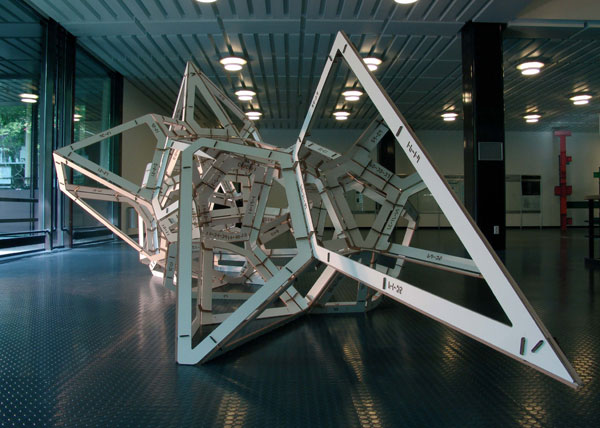
"An experimental construction is on exhibition. It chronicles the research, experimentation, and development undertaken by the postgraduate students in Computer Aided Architectural Design (CAAD) 2004-05. Within a three months period, the participants designed, programmed, and fabricated an irregular spatial structure, showing the potential of the „digital chain“; the entirely digital process from design through to production.
The concept of the design is based on cellular automata. It creates a self organised growing mesh where the designer is able to directly interfere with the running design by changing parameters and positions of the structural nodes. A computer simulation model was programmed in Java, using 3D API to visualize the design state in three dimensions. The resulting mesh is fl exible and manipulable, allowing it to adapt not only to the user defi ned parameters but also to contextual elements.

Intertwined with the design process, construction studies and fabrication systems were developed for production using the CNC machines located at ETH Hönggerberg. Using construction data directly derived from the 3D-model, m.any variations can be generated and easily outputted.

The final fabricated result should be regarded as a structure and proof of concept, showing the potential for using current information technologies in architectural design and construction. "