Tuesday, December 12, 2006

Ambient Addition

Found this over at archinect, thought it was an interesting link for Sam.

"Ambient Addition is the thesis project of MIT Media Lab research assistant Noah Vawter. It is a Walkman which, rather than isolating the user from the outside world, processes the sound of the environment into music... almost like having Mathew Herbert in your pocket. As a result, users become more engaged and aware of their surroundings, "tend to play with objects around them, sing to themselves, and wander toward tempting sound sources." Watch a demonstration clip at Noah's website."

mediaarchitecture.org

http://www.mediaarchitecture.org/ - a very cool blog i just found highlighting a number of built architectural projects around the world utilizing multimedia installations and lighting to augment the spatial and visual experience of the building/space. check it out...lots of cool stuff.

more video from Studio Greg Lynn


Video short focused on the students and their work in the architecture design studio of Greg Lynn at the University of Applied Arts (Universität für Angewandte Kunst, Wien) in Vienna. By David Fenster.

Dune 4.0: An Interactive Landscape


Dune 4.0, developed by Daan Roosegaarde, is an interactive landscape which physically changes its appearance in accordance to human presence.

Friday, December 08, 2006

education of discovery and surprise

next_platform 06-07 _isd_ chelsea college of art and design_UAL
In the age of postmodernism, there is always infinitive answer on any question we raise but it also opens a journey for searching and discovering. This is also an opportunites for students who are supposed to be creative enough to find their lanugaue in spatial expresssion and its experience. The word "interesting idea" is needed to be critically defined at some point and be translated in to a series of spatial design strategies. Argument and debate are allowed to brainstorm possibilities in a new condition. This is the reason why education is important. To educate and to be enlighten.

In search for new aesthetics is our platform approaches to question what are the possible outcomes to define spatial formation. Student to be informed and inspired, actively using new design technologies to try on new combination and mixture. The more challenge to think differently, the more close to our new discovery. This is why educational environment is not setting up a boundary but the students are setting their own goal to archieve. At the end, what they establish is an attitude to question and unsetteld in their answer. Then their finding is become driven by this motivation to feel they are being, being in the world full of discovery and surprise.

Monday, December 04, 2006

Harvard GSD Lecture Webcasts

A an archive of webcasts from this years lecture series at the Harvard Graduate School of Design. Some really impressive speakers here, including:

Rem Koolhaas - OMA
Ali Rahim - Contemporary Architecture Practice
Ben Van Berkel - UN Studios
Jeff Kipnis
Jan Kaplicky - Future Systems

Playing to Learn

PLAYING TO LEARN

Are video games useful educational tools? Some believe games have a bad influence on children, but many regard them as a useful complement to traditional teaching and learning. Games are becoming more common in the classroom, but how effective are they?

Interactivity, exploration and use of imagination are all important elements of gaming as well as for learning. There are many games available that allow users to be creative and investigate. But when pupils use games are they learning about the educational principles behind them or just becoming better gamers? What are the challenges in creating an engaging classroom experience that can deliver the right kind of information?

Education and learning are never one-size-fits-all experiences; people learn in many different ways. Is interactive technology suitable for everyone? Find out if computer games really could provide a teaching revolution. Is the classroom of the future just a mouse click away?

Event organised by:
The Science Museum.

Speakers:

Kairen Cullen, educational psychologist
Adrian Hall, Director of Mobile Learning, Steljes Ltd
Steve Heppel, government adviser on technology in schools
Martin Oliver, lecturer, Institute of Education

Host:
Bill Thompson, technology blogger, BBC

Supported by Nintendo

Friday, December 01, 2006

Giant Robot Architecture

Recent work from Studio of architect Greg Lynn at the Angewandte in Vienna channels the aesthetic culture of robots to produce new forms of architectural spectacle. The studio is documented in a video by David Fenster and Brennan Buck.

Wednesday, November 22, 2006

Flight Patterns as a dynamic diagram

Very cool dynamic diagrammings created from data from the US aviation administration. PLEASE check this out!!

Monday, November 20, 2006

Mount Fear - Abigail Reynolds


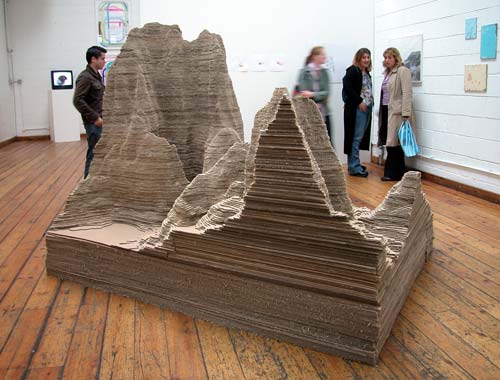
Abigail Reynolds explores the documentation and presentation of information by restructuring them to life-sized, tangible models. One of these is Mount Fear, the artist’s interpretation of police statistics. The series of works is based on the violent crimes committed in urban areas such as Manchester and East London within the time span of one year. The statistics are digitally plotted by a computer programme to form undulating three-dimensional terrains. Reynolds constructs a model of this terrain using Styrofoam and corrugated cardboard, creating a conceptual landscape where each criminal incident adds to the scale of the model: peaks represent high crime levels and valleys are areas of low crime.

The experience of urban life is expressed in the treacherous summits and safe troughs of Reynolds’ sculptural forms. Crime is a grim reality on the city streets, yet Reynolds records it paradoxically by alluding to the language of Romantic landscape painting and the dream of rural escapism. Just as the Romantic poets and painters expressed their sense of awe at the majesty of nature, Reynolds shows a similar sense of wonder at the world of information systems and data. The assumed authority of these data is expressed in the impressive scale of the models. Mount Fear uses statistics to express an unexpected narrative about the urban landscape. In her attempts to pin down dynamic, shifting aspects of social behaviour, Reynolds allows the audience to wonder at the truth of this urban narrative. Statistics are numbers representing facts, and yet they allow ample room for an interpretation of these facts. Reynolds questions the authority of numbers and the ways in which they are exploited, which lends her work a subtle political undertone. For the exhibition at MU Abigail Reynolds will transform the crime rates of several areas in Eindhoven to a new work. This work will be presented at MU together with the London and Manchester sculptures and many drawings.

Abigail Reynolds (1970) is a graduate of the famous Goldsmiths College, where she completed an MA in Fine Art, and Oxford University where she studied English Literature. She lives and works in London and lectures at Chelsea College of Art and Design. Reynolds is principally working with digital media. Her interest in the recording and configuration of information is continued in her current role as artist-in-residence at the reputed Oxford English Dictionary where she is tracking the impact of Britain’s colonial past on the English language. Abigail Reynolds exhibited before in London, Zurich, Helsinki, Vienna and Toronto.

Some more from the web about her:
http://www.abigailreynolds.com/news/newsindex.html

Friday, November 17, 2006

Data Artist


Visualization is an important technique in communication our mind. What is envisioning a concept? From quantifing information to anaylsis them as a stratgy of concpet thinking. Edward Tufte is a professor at Yale University, where he teaches courses in statistical evidence and information design. His books include Visual Explanations, Envisioning Information, The Visual Display of Quantitative Information, Political Control of the Economy, Data Analysis for Politics and Policy, and Size and Democracy (with Robert A. Dahl). He is a fellow of the American Statistical Association, the American Academy of Arts and Sciences, the Guggenheim Foundation, and the Center for Advanced Study in the Behavioral Sciences. He has received honorary doctorates from The Cooper Union and Connecticut College, the Phi Beta Kappa Award in Science, and the Joseph T. Rigo Award for contributions to software documentation from the Association for Computing Machinery. Do check it out his website.

http://www.edwardtufte.com/tufte/index

Thursday, November 16, 2006

How are WE feeling today??


This is an interesting website I found today, that maps and displays "feelings" posted on the internet. It might help those of you (nihal?) who are considering mechanisms which deal with mood/emotion. check it out:
http://www.wefeelfine.org

"We Feel Fine is an exploration of human emotion on a global scale.

Since August 2005, We Feel Fine has been harvesting human feelings from a large number of weblogs. Every few minutes, the system searches the world's newly posted blog entries for occurrences of the phrases "I feel" and "I am feeling". When it finds such a phrase, it records the full sentence, up to the period, and identifies the "feeling" expressed in that sentence (e.g. sad, happy, depressed, etc.). Because blogs are structured in largely standard ways, the age, gender, and geographical location of the author can often be extracted and saved along with the sentence, as can the local weather conditions at the time the sentence was written. All of this information is saved.

The result is a database of several million human feelings, increasing by 15,000 - 20,000 new feelings per day. Using a series of playful interfaces, the feelings can be searched and sorted across a number of demographic slices, offering responses to specific questions like: do Europeans feel sad more often than Americans? Do women feel fat more often than men? Does rainy weather affect how we feel? What are the most representative feelings of female New Yorkers in their 20s? What do people feel right now in Baghdad? What were people feeling on Valentine's Day? Which are the happiest cities in the world? The saddest? And so on.

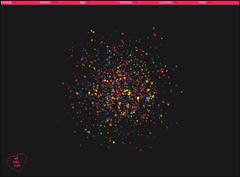
The interface to this data is a self-organizing particle system, where each particle represents a single feeling posted by a single individual. The particles' properties – color, size, shape, opacity – indicate the nature of the feeling inside, and any particle can be clicked to reveal the full sentence or photograph it contains. The particles careen wildly around the screen until asked to self-organize along any number of axes, expressing various pictures of human emotion. We Feel Fine paints these pictures in six formal movements titled: Madness, Murmurs, Montage, Mobs, Metrics, and Mounds.

At its core, We Feel Fine is an artwork authored by everyone. It will grow and change as we grow and change, reflecting what's on our blogs, what's in our hearts, what's in our minds. We hope it makes the world seem a little smaller, and we hope it helps people see beauty in the everyday ups and downs of life."

Canary Wharf: Hi-Tech Wilderness


London's Canary Wharf business district is in many ways an undeveloped development. As an address and physical location for grand-scale office developments it is an effective and well constructed machine. As a human environment however, it is uninviting and seems insensitive to the modifying touch of its many daily users.

I am interested particularly in Montgomery Square; a bleak, largely grey space to the east of Jubilee Gardens, between the Clifford Chance and BP/McGraw Hill buildings.
Currently the square is windswept and forgotten, used only as a circulation route.
As such it epitomises the less lovable traits of the development; people pass through on their way to somewhere else, never ever lingering to enjoy the space itself.
Around Canary Wharf there are half a dozen sculptures. Though they vary in style, all are abstractions of the human form, as if the environment is only habitable to beings of metal and stone. Inside the skyscrapers and office blocks meanwhile, real people operate in carefully controlled comfort; their climates controllable at the touch of a mouse or keyboard.

This contradiction is fascinating. Why must a modern, technologically exacting development be so faceless? This question can be answered to a degree through considerations of efficiency, but not wholly. After all, there are areas such as Montgomery Square with no apparent reason for remaining undeveloped.
This square would benefit enormously were the Ambient Intelligent technologies coursing through the areas' buildings and airwaves utilised to create a public space appropriate and beneficial to the environment surrounding it; A demonstration that AmI's are essentially human technologies created by and for humans, not something debilitating to the human spirit.

Monday, November 13, 2006

Bored? When you are waiting??


What does a bus station mean? What is the purpose of a bus station? Can we bring a new meaning to a bus station?

These questions I have been asking myself for the past week.
The site is London Victoria Bullied Way, Greenline Coach Station as seen on the photo.

I have chosen this site because of my personal experience. I have travelled myself long journeys by buses and have waited several hours till the bus arrives. This is an open air bus station so nowadays during the upcoming winter period it gets cold. There are some coffee shops and eating places around but what if you dont want to wait inside or you find yourself without money. There are no announcements so if difficult to know when and where from the buses are leaving. You can find some seats which you can use but are uncomfortable for longer period.

Imagine youself waiting for a bus. To pass on the time you read a book or listen to music but what if you don't have any of these things. The time turns into a very slow pace factor and you start to seek for some kind of change than just looking around and day dreaming.

My proposal wants to introduce ambient intelligence to tackle these problems of the site and change them into more habitable environment. An environment where are elements which help you to change the experience of waiting. I want to try to make people think of a bus station differently.

I understand that bus stations are not made for waiting long periods of time but why does it have to be unpleasant experience. It's about creating new oppurtunities and options.

From some people a bus station is an end destination to their journey but for some it is the start.

Monday, October 30, 2006

Les Triplettes de Belleville


Hello!

I thought about this movie after Sam's presentation!It's a musical animated movie; this is a clip of the song!Just to prove that we can make music with everything!

Something that everyone can enjoy. Nothing to do with AmI!!!=) Enjoy

http://www.youtube.com/watch?v=pMzoNO3wdY4&mode=related&search

http://www.imdb.com/title/tt0286244/

http://www.lestriplettesdebelleville.com/

Friday, October 27, 2006

interactivearchitecture dot org

here's a link to a very cool website i found today, which relates to our research agenda on many levels. lots of interesting projects posted on there, from installations to objects digital environments....check it out:
http://www.interactivearchitecture.org

"Interactive Architecture dot Org is a research platform set up by Ruairi Glynn to support the ongoing work of the Interactive Architecture Workshop. It explores the emerging practice within architecture that merges digital virtual experiences and technologies with tangible and physical spatial experiences."

Thursday, October 26, 2006

An interactive cinema in Bath, by Martin Reiser

check out this link to a very cool installation for an interactive cinema earlier this year in bath, by martin reiser. visitors are tracked, and "followed" by interactive "hosts". very cool. here is some of his text:

"Vertical screens are placed at strategic opposite points of the space. A visitor triggers the presence of a variety of unfocused and evanescent video characters through the use of positional detection devices (Chirpers) and interpretative software. Individual characters appear at random and smile, beckon or otherwise indicate that the visitor[s] should follow them and pass onwards from screen to screen, keeping pace with the visitor[s]. These "hosts" will be of a wide range of ages, gender, social types and races, but will always appear singly to the participant.


A 3D audio landscape of footsteps, acapella tonal voices and breathing sounds will accompany the visitor between the screens and form a tangible changing audio landscape. The artist will work with a group of singers, musicians and sound designers in Bristol/Bath on this aspect of the piece.


If a visitor stands for more than a few seconds in front of a particular screen, the figure will turn in the direction of the viewer and return the visitor[s] stare. The video sprite will look the visitor up and down, or turn away in distraction and then speak a series of poetic aphorisms, also seen as animated text on the screen."

Wednesday, October 25, 2006

Ambient Intelligent as a public arts - D-tower


Ambient intelligent is something where existed but can not been seen. But if you look at it in a spatial context it can be anthing and every. But my understanding of it is far more than just a remote control but an intelligent system which learn and remeber like a human. When you understand how it tights up with a spatial context, it like a messager, a postman. It holds all the information and "know" the ways how they can be delivered. I have attached a link with the title call "D-tower". This is a project in 2004 commissioned by the city of Doetinchem in the Netherlands, that maps the emotions of the inhabitants of Doetinchem. D-tower measures HAPPINESS, LOVE, FEAR and HATE daily using different questions. What technology is not replacing but enhancing. Have you ever send out a message to someone to express your love? What do you feel? It is a "field" of love.

Friday, October 20, 2006

Kevin Kelly speaking this weekend at Pop!Tech:Live


For those looking for more inspiration for their work...check out the streaming lecture of Kevin Kelly (and many others) this weekend at Pop!Tech:Live. Kevin is the founder of Wired Magazine, and author of the seminal book Out of Control, where he informs us that the most intelligient machines and technologies are those that move towards biology:

  • As we make our machines and institutions more complex, we have to make them more biological in order to manage them.

  • The most potent force in technology will be artificial evolution. We are already evolving software and drugs instead of engineering them.

  • Organic life is the ultimate technology, and all technology will improve towards biology.

  • The main thing computers are good for is creating little worlds so that we can try out the Great Questions. Online communities let us ask the question "what is a democracy; what do you need for it?" by trying to wire a democracy up, and re-wire it if it doesn't work. Virtual reality lets us ask "what is reality?" by trying to synthesize it. And computers give us room to ask "what is life?" by providing a universe in which to create computer viruses and artificial creatures of increasing complexity. Philosophers sitting in academies used to ask the Great Questions; now they are asked by experimentalists creating worlds.

  • As we shape technology, it shapes us. We are connecting everything to everything, and so our entire culture is migrating to a "network culture" and a new network economics.

  • In order to harvest the power of organic machines, we have to instill in them guidelines and self-governance, and relinquish some of our total control.
(By the way, the book is available for free online HERE)

Monday, October 16, 2006

KINETICA opens...


Kinetica is the UK's first museum of kinetic art. It will actively encourage the convergence of art and technology, providing an exhibition space in central London where the most important examples of kinetic, technological and electronic art, both past and present, can be properly stored and displayed.

Our vision is to create both a historical and contemporary art collection of seminal and cutting-edge multi-disciplinary works that date back from the 1920s through to the present day, focusing on the pioneering and influential importance of such works.

At Home with Replicants: The Architecture of Blade Runner

At Home with Replicants: The Architecture of Blade Runner by Andrew Benjamin Where is the future? How will it be built? One way of taking up these questions would be to follow the presentation of the architectural within films that seek to project the future. The essay give you an good look at architcture and the sci-fic movie.

Blade Runner Analysis


Blade Runner is one of the great films of the twentieth century. There are many reasons that contribute to this. There is the obvious enjoyment one can have of simply watching a fantastic film with interesting characters in a stunningly created environment set to terrific music. But there is also much more depth to this particular film. It addresses some of the eternal questions that humans have asked for centuries, for example:
"What does it mean to be human?""What is reality?""What is the difference between real memories and artificial memories?""How does our environment affect us?""What are the moral issues we face in the creation of artificial people?" This is a good link to some inspiring essay which give us a broder idea of ambient intelligent.

developable surfaces...from paper to pixel to plate


nihal's comment below, which links to the beautiful developable surface paper models of richard sweeney reminded me of the work being done by algorhythyms on the fabrication and design of sheet metal developable surfaces by haresh lalvani over at pratt in nyc. this article from metropolis mag is a good read regarding the process they have developed: Bend the Rules.

Friday, October 13, 2006

Techniques and Technologies in Morphogenetic Design Symposium

AA and AD Wiley SymposiumTechniques and Technologies in Morphogenetic Design Thursday 16 March, 10.00 Lecture Hall The symposium, moderated by Christopher Hight, will introduce the interrelated concepts of self-organisation and emergence in relation to morphogenetic design, as well as relevant methods, techniques and technologies. The event also marks the launch of Techniques and Technologies in Morphogenetic Design by AD Wiley, guest-edited by Michael Hensel, Achim Menges and Michael Weinstock. The link provide a passage on one of the talk by Michael U. Hensel on that day.

Monday, October 09, 2006

Teaching Studio


Next platform contain a teaching studio in a matrix-university to train up students to explore the truth of spatial design. This version we set up a year agenda about designing a Public Space of Ambient intelligent. We have 16 students are joining this studio which will undergo a series of investigation of this ubiquitous computing and how is now transforming our behaviour and pattern of using public space. This is a challenge and also an excitement within an academic environment in responding an emergence issue of our social situation. We make use of this open channel to attract different discipline in participating our workshop and do beleive collaborative working mode could expand our ways of looking at design.

Saturday, October 07, 2006

about NExT platform

NExT - the New Experimental Tectonic
The NExT platform uses digital tectonics as a interface to pose a series of questions relating to our design of space. We study how emergent design methods can transform our understanding of our environment as well as finding new possibilities in spatial design strategies of spatial Through digital interface we explore new methods in design process, looking at new applications of material and pushing the boundaries of our spatial experience

This network link up with students, artists, designers and professionals to seize for opportunities working collaboratively and exploring new design thinking. We encourage people to discuss all things related and unrelated about built environment, sharing ideas, knowledge, and skills. The words NExT giving us to question what could be possible and how far can we go in order to find out the presence and build up our future.